Climate 2013: Perspectives of 8 Scientists
Published on Dec 19, 2012
Videographer Peter Sinclair captures the views of eight scientists representing some of the nation’s leading research institutions in a concise video newly produced for The Yale Forum.
What Scientists Are Seeing Over Antarctica
NASA’s Operation IceBridge has launched its Antarctic 2012 campaign, flying high-priority missions measuring polar ice from a base of operations at the tip of Patagonia on the Strait of Magellan. They have even made a return visit to the Pine Island Glacier, the site of last year’s discovery of a massive rift in the ice.
Sea ice doesn’t always hold the allure of a massive ice sheet, or a crevassed blue glacier spilling between mountains, but it comes in array of shapes and sizes and has its own ephemeral beauty. Operation IceBridge studies sea ice at both poles, and also runs across interesting formations on route to other targets. Operation IceBridge returned to the Pine Island Glacier twice in 2012, and NASA glaciologist Kelly Brunt discusses the implications of the glacier’s impending calving event.
Operation IceBridge has now returned to the Pine Island Glacier, not once, but twice in 2012. And the year-old giant crack in the glacier, poised to create an iceberg the size of New York City? Well it’s still there, and that iceberg has yet to break free. But the rift has grown longer, much wider, and spawned a secondary crack. Before we talk about when that mighty berg will be born, let’s take a look at the IceBridge missions themselves. IceBridge’s first return to the region was a high altitude flight over the entire region, including the Thwaites, Smith, and Kohler glaciers. After this campaign is over, scientists will be able to compare this broad survey with previous years’ measurements in order to better document the rapid and widespread changes in the region over time.
Anti-soot policy can solve 15% climate change within decade
Like many before him Jacobson argues the role of soot – or ‘black carbon’ – is being ignored in the international efforts to combat climate change. After CO2 soot is the most important contributor to global warming, not because it would be a greenhouse gas [soot particles after all are solid], but because soot lowers the Earth’s albedo, transforming solar radiation to heat radiation.
Soot aerosols even decrease the albedo of ‘space’ as it also absorbs a portion of the solar radiation that was already reflected by Earth’s surface, capturing the energy in midair just before it could escape and thereby creating more heat, further warming the atmosphere.
What’s new to Jacobson’s story is firstly his call to action. He states through aggressive anti-soot policy, by combined targeting of all sources from exhaust filters for vehicles to cooking stoves to replace wood fires in poor nations, ‘within 5-10 years’ worldwide soot emissions could be reduced by 90 percent.
The benefits of this are also somewhat larger than previously thought. Jacobson says his calculations show an additional reason why soot is ‘bad for the climate’: soot particles disturb an even cloud cover, thereby further reducing the Earth’s general albedo.
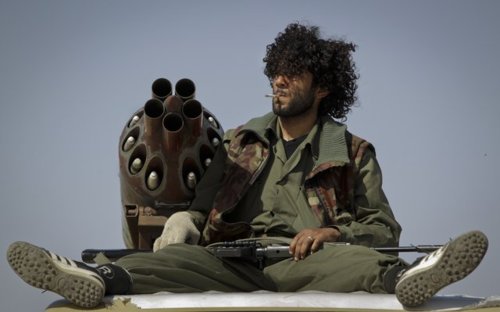
Hipster Rebels In Libya
In every subsequent photo we see of the Libyan rebels, they get more and more fucking hipster. Don’t be shocked if this is what the next seasonal Urban Outfitters looks like.

Killed as a search term
For years I’ve Googled the word “killed” two to four times a week - I click on “News” and then on “Last 24 hours” in a routine I use to find stories about terror attacks. This is because after journalists quit using the word “terror” and “terrorism” to describe terror attacks it was still necessary to find the stories about terror attacks if you were following the war on terror.
The good news is that terror attacks outside of war zones and the strife torn border areas (Afghanistan, Yemen, Pakistan, West Bank, Gaza, Somalia, etc.) are way down. Now a typical search for “killed” in the last 24 hours will net you people killed in traffic accidents, some of our war dead, and very rarely a terror story. During 2006-2008 there were multiple terror stories every day from multiple countries, and there was a vast improvement post election 2008.
Say what you will - but you can’t fail to notice that something has changed. Is that the right word? Change?
Algeria’s police crack down on protesters
Egypt: A Nation in Waiting
Um…yeah. It’s a little strange that this historical video by Al Jazeera has been abruptly removed. If anyone knows of another copy or can shed light, let us know.
Motley Moose: Real Change Takes Time
Real Change Takes Time: Lesson #6,743
The stakes are high, but it’s evident to anyone who’s even remotely paying attention that the GOP are willing to sacrifice the nation, over the well being of citizens, in their quest to achieve and maintain political power.
What’s harder for me to stomach is the bizarre intransigence from the left of center folk who decry ‘incrementalism’. We saw this all throughout the healthcare debate; we saw it again with DADT, and again with FinReg. Nothing has been good enough for these people. Nothing.
Again and again, over and over, issue after issue. I’m not talking about the general swath of leftward-leaning people who have disappointments. I have a few of my own. I’m talking about the self-absorbed, holier-than-thou lefty [filter-unfriendly word] who are willing to hand control back over to the aforementioned power-mongering GOP, purely out of spite.
SRSLY people, let’s get a [filter-unfriendly word] grip. Change takes time. Given the challenges we face as a nation, now is most assuredly not the time for poutrage.