In Native Populations' Struggle to Overcome Domestic Violence, Survivors Play a Pivotal Role
Leave Before He Kills You: In Native Populations’ Struggle to Overcome Domestic Violence, Survivors Play a Pivotal Role
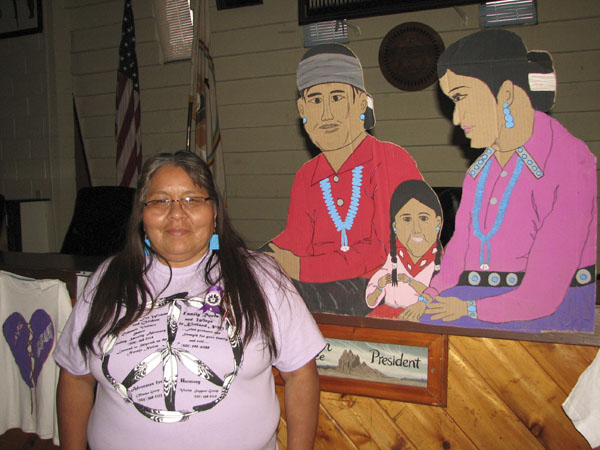
Eleanor, a domestic violence survivor, tells her story at gatherings like this candlelight vigil in order to help other survivors heal.
Najaway, a Navajo woman, survived 20 years of domestic violence at the hands of two husbands—one Native, one non-Native. Now in her early 50s, she still can’t get the nightmare out of her head.
“I remember my daughter looking at me after I was beat down and covered with bruises, saying, ‘Mom, you should go away and not come back, because Dad might kill you,’” Najaway recalls. “She was all of six years of age.”
And she is one of the lucky ones. In some communities, Native American women are murdered at a rate more than 10 times the national average. Nearly half of all Native women have experienced rape, physical violence or stalking by an intimate partner, according to federal crime and health data.
[…]
Still, there is hope. In places where justice cannot reach, survivors are coming out of the shadows to tell their stories, reliving the pain in order to help others avoid similar suffering. Over the past two months, SFR interviewed six Native people—five women and one man—each of whose life has been touched by domestic violence. Individually and together, they’re working to build a long-term solution that heals past abuses, restores traditional practices and funds community programs and services.
It is, at the very least, a start.
[…]
Navajo medicine man Johnny Henry Jr. stresses the importance of integrating traditional beliefs into the healing process.
The same author published a related story in another venue, radio station KUNM. In this one, she writes about the Violence Against Women Act.
[…]
A 1978 Supreme Court decision ruled that tribes can’t prosecute non-natives who commit criminal acts on their lands. Arthur Michaels is a tribal prosecutor in Espanola. He says the court ruling is just wrong. “It’s abhorrent and it’s injustice not to have non-Indians prosecuted on Indian lands when they commit the crime on Indian lands.”
Michaels says that this ruling keeps tribal communities from obtaining justice. He explains that when a non-native abuses or kills a native woman, the case goes to federal agencies like the FBI, and this could take up to two years to prosecute. “First, they have to determine if you did it. They have to determine if it’s a misdemeanor or a felony; then they have big case loads. So, justice is not done, justice delayed is justice denied.”
This past year, tribes fought to get their power to prosecute non-natives back through a provision in the reauthorization of the Violence Against Women Act. The bill stalled last year because of continued concerns about the non-native defendant’s civil rights. But, advocates say these concerns are unfounded, because the proposed law protects their rights, like the right to a public defender The bill also provides funding for domestic violence services.
[…]
There’s audio at this link, and the same video is at both the Santa Fe Reporter and KUNM. There are also more photos at each link. I assume the author is the photographer as well. Photo credits are not given.